
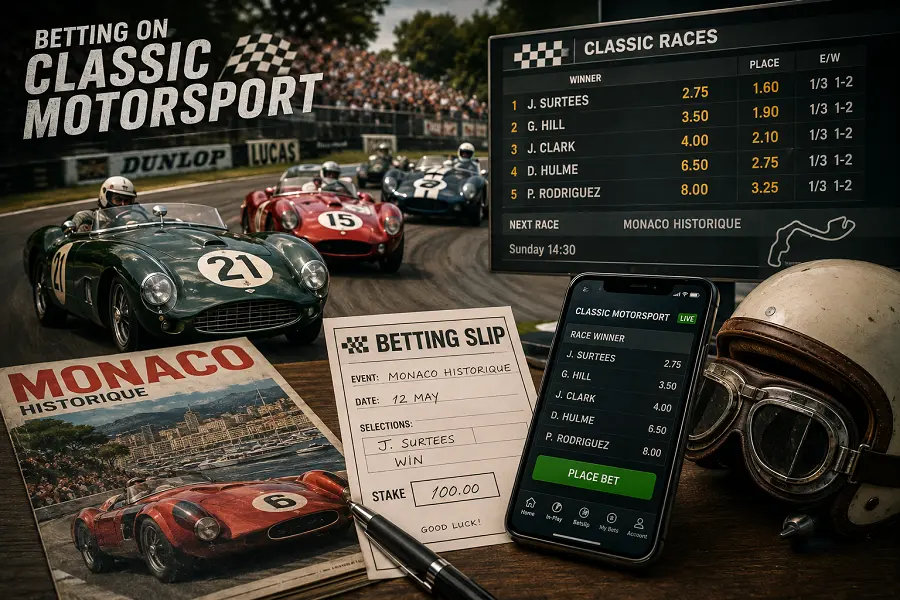
There is a particular thrill that comes from watching a beautifully restored pre-war racer power through a hairpin bend at speed, tyres howling, engine note echoing off the grandstands, driven by someone who understands exactly what that machine is capable of and exactly how far they can push it. Historic motorsport events like the Goodwood Revival and the Mille Miglia have grown enormously in popularity over the past two decades, drawing crowds who appreciate both the mechanical artistry of the cars and the genuine competitive skill on display. For classic car enthusiasts who already spend their weekends poring over provenance documents and debating the merits of numbers-matching engines, these events offer something extra: a genuine opportunity to apply that same analytical eye to betting markets built around historic motorsport. This guide covers how to approach wagering on these unique events sensibly and intelligently.
Why historic motorsport betting is genuinely different
Betting on historic motorsport events differs substantially from betting on modern Formula 1 or contemporary rallying, and understanding this difference is the first step toward betting on it well. Modern motorsport betting markets are built around performance data, telemetry, lap times and manufacturer development budgets that are tracked obsessively by analysts and bookmakers alike. Historic motorsport events operate on almost the opposite principle: the cars themselves are often decades old, driven by a mix of professional racing drivers, wealthy amateur owners and everyone in between, and the emphasis is frequently as much on preservation and sporting spirit as on outright competitive dominance.
This creates a market that is considerably less efficiently priced than modern motorsport betting, which is exactly the kind of environment where genuine enthusiasts with real knowledge of the cars, drivers and event history can find value that a purely statistical model would miss entirely. Someone who understands why a numbers-matching Jaguar D-Type might handle differently from a well-restored but non-original replica has a genuine informational edge that most casual bettors simply do not possess.
The Goodwood Revival: betting on preservation as much as pace
The Goodwood Revival is unique among major motorsport events in its explicit celebration of period authenticity, and this extends directly to how races unfold and how betting markets should be approached. Entrants are judged not just on speed but on the correctness and originality of their machinery, and many owners drive with genuine restraint to protect cars that are, in some cases, irreplaceable pieces of automotive history. This means that raw pace figures from qualifying can be genuinely misleading indicators of how a race will actually play out, since a driver in an extremely valuable or rare car may simply choose not to push to the limit regardless of their actual pace potential.
Successful betting on Revival races requires research well beyond published lap times. Understanding a specific car’s history, whether it has a reputation for reliability issues, how its current owner and driver typically approach wheel-to-wheel racing and which entrants are known for genuinely competitive drives versus careful exhibition running all factor into a properly informed betting decision. This is precisely the kind of detailed, provenance-focused research that anyone who has spent time verifying a classic car’s authenticity before a purchase will already find completely natural.
The Mille Miglia: endurance, navigation and the unpredictable Italian roads
The Mille Miglia presents an entirely different betting challenge, since it is fundamentally a regularity rally rather than an outright speed race. Competitors are scored on their precision in hitting exact target times across the thousand-mile route through the Italian countryside, which means that betting markets here reward an appreciation for consistency, navigation skill and mechanical reliability over raw horsepower. A beautifully powerful but temperamental car is a considerably worse betting proposition than a less glamorous but bulletproof machine driven by a crew with genuine navigational discipline.
Weather and road conditions play an outsized role in Mille Miglia outcomes compared to closed-circuit historic racing, since the event traverses public roads across a full day and often into the night. Bettors who track weather forecasts along the specific route and understand which teams have historically performed well in adverse conditions hold a genuine edge over those betting purely on reputation and horsepower figures.
Understanding the betting markets available
Historic motorsport betting typically offers a narrower range of markets than mainstream sports betting, but the markets that do exist reward careful analysis. Outright winner markets are the most straightforward, betting on which entrant will take overall victory in a given class or event. Class winner markets narrow the field to specific car categories, which is often where the most interesting value exists, since a knowledgeable bettor who understands the relative competitiveness of, say, the pre-war sports car class versus the post-war GT class can find considerably better odds than in the more heavily bet outright winner market.
Head-to-head markets, betting on which of two specific entrants will finish ahead of the other, are increasingly available for the more prominent rivalries within historic racing, and these markets often reward the kind of detailed, car-specific knowledge that dedicated restoration enthusiasts already possess in abundance.
Building your own historic motorsport betting approach
The most successful approach to betting on events like Goodwood and the Mille Miglia mirrors the same disciplined research process that goes into evaluating a classic car before a restoration project or purchase. The meticulous, provenance-first restoration philosophy behind Restyle it translates directly to the betting slip: start by studying the entry list well in advance, researching the specific history and known characteristics of the cars and drivers involved, exactly as you would research a car’s provenance and history before agreeing a purchase price. Pay attention to recent results at similar events, mechanical reliability track records and any known changes to a car’s setup or ownership since its last outing.
Treat published odds with the same healthy scepticism you would apply to an auction listing claiming a car is fully numbers-matching without documentation to prove it. If a market seems mispriced based on your own research, that discrepancy is exactly where genuine betting value tends to live, whether that means backing an underdog whose mechanical reliability you trust more than the market does, or avoiding a heavily backed favourite whose car has a documented history of retiring from similar events.
Managing your betting bank sensibly
As with any form of wagering, historic motorsport betting deserves the same financial discipline that a serious restoration project demands. Set a fixed budget for the season or event before you place a single bet, and treat it exactly as you would a restoration budget: a firm ceiling that does not move regardless of how tempting a particular wager looks in the moment. Stake a consistent, modest proportion of that budget on each bet rather than varying your stakes based on confidence or excitement, which protects you from the kind of overcommitment that can undo an otherwise well-researched approach.
Where to explore casino entertainment alongside motorsport betting
For enthusiasts who enjoy the analytical satisfaction of historic motorsport betting and want to explore other forms of odds-based entertainment during the quieter periods between race weekends, a broader casino platform can be a natural complement. Pronto bets casino offers a wide range of casino games alongside sports betting markets, giving motorsport fans somewhere to apply the same careful, research-driven mindset to table games and slots when there is no historic race meeting on the calendar. As with motorsport betting, checking the published odds and rules of any game before committing real money is simply good practice, the same due diligence habit that serves restoration enthusiasts so well when evaluating a car before a purchase.
Responsible betting for motorsport enthusiasts
Historic motorsport culture has always understood the value of patience, careful preparation and knowing your limits, whether that means recognising when a car needs rest during a long rally or recognising when a betting session has run its natural course. Bringing that same sensibility to wagering means setting firm boundaries before you bet and treating any win as a pleasant bonus rather than an expectation. If betting ever starts to feel difficult to control, free and confidential support is available. BeGambleAware provides advice and support for anyone with concerns about their gambling behaviour.
Conclusion
Betting on historic motorsport events like the Goodwood Revival and the Mille Miglia rewards exactly the kind of detailed, provenance-focused research that classic car enthusiasts already bring to their restoration projects. Understanding the cars, the drivers and the specific character of each event gives knowledgeable bettors a genuine edge in markets that remain considerably less efficiently priced than mainstream motorsport betting. Approached with the same discipline and patience that defines a good restoration project, historic motorsport betting offers a genuinely satisfying way to engage more deeply with the sport, provided it is always done within sensible, predetermined limits.